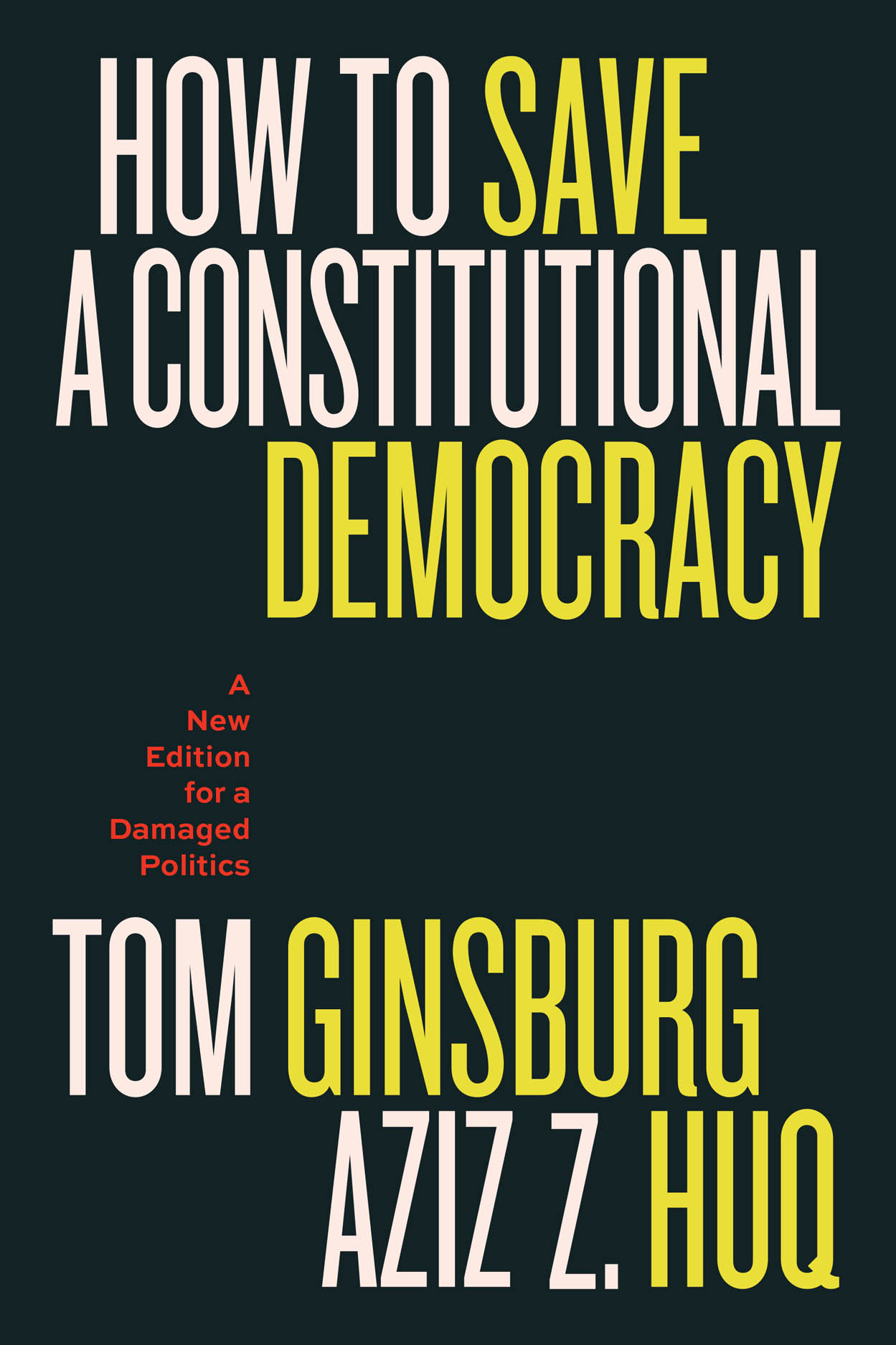
How to Save a Constitutional Democracy
A New Edition for a Damaged Politics
Second Edition
How to Save a Constitutional Democracy
A New Edition for a Damaged Politics
Second Edition
Updated to take stock of recent developments, Tom Ginsburg and Aziz Z. Huq’s prescient and insightful book shows how constitutional rules both hinder and hasten democratic decline.
Around the world, autocratic leaders threaten the core structures of democratic self-rule. But democratic constitutions are not fail-proof safeguards. By looking at how such leaders exploit legal mechanisms to advance their aims, we can see how democratic constitutions can sometimes abet—and even accelerate—democratic decline. In this new edition of How to Save a Constitutional Democracy, constitutional law experts Tom Ginsburg and Aziz Z. Huq offer a powerful analysis of today’s challenges while arguing that the time has come for meaningful, actionable change.
This new edition takes up the torch of its predecessor, canvasing developments in the United States and other countries that have transpired since 2018. Drawing lessons from countries around the world and reflecting on the prospects for American democracy, the authors show how constitutional design can, in fact, either undermine or support democratic institutions. The sobering reality for the United States is that the Constitution’s design makes democratic erosion eminently feasible. But Ginsburg and Huq do not stop there. They suggest practical ways that law and constitutional design can better manage these mounting threats, analyzing constitutional and legal questions that are consequential yet poorly understood, all while cautioning against an overreliance on technocratic fixes.
Even more urgent and salient in its new edition, How to Save a Constitutional Democracy reflects on why autocrats tend to pose even greater danger the second time they come to power and asks how we can begin to repair a democracy that has failed.
344 pages | 3 halftones, 2 line drawings, 3 tables | 6 x 9 | © 2026
Law and Legal Studies: The Constitution and the Courts
Political Science: American Government and Politics, Public Policy
Reviews

Table of Contents
Preface
Acknowledgments
Introduction
1. Liberal Constitutional Democracy and Its Alternatives
2. Two Pathways from Liberal Constitutional Democracy
3. When Democracies Collapse
4. When Democracies Decay
5. Will American Democracy Persist?
6. Making Democratic Constitutions That Endure
7. Saving Democracy, American Style
Conclusion: On Fighting Democratic Erosion
Afterword: March 2026
Notes
Index