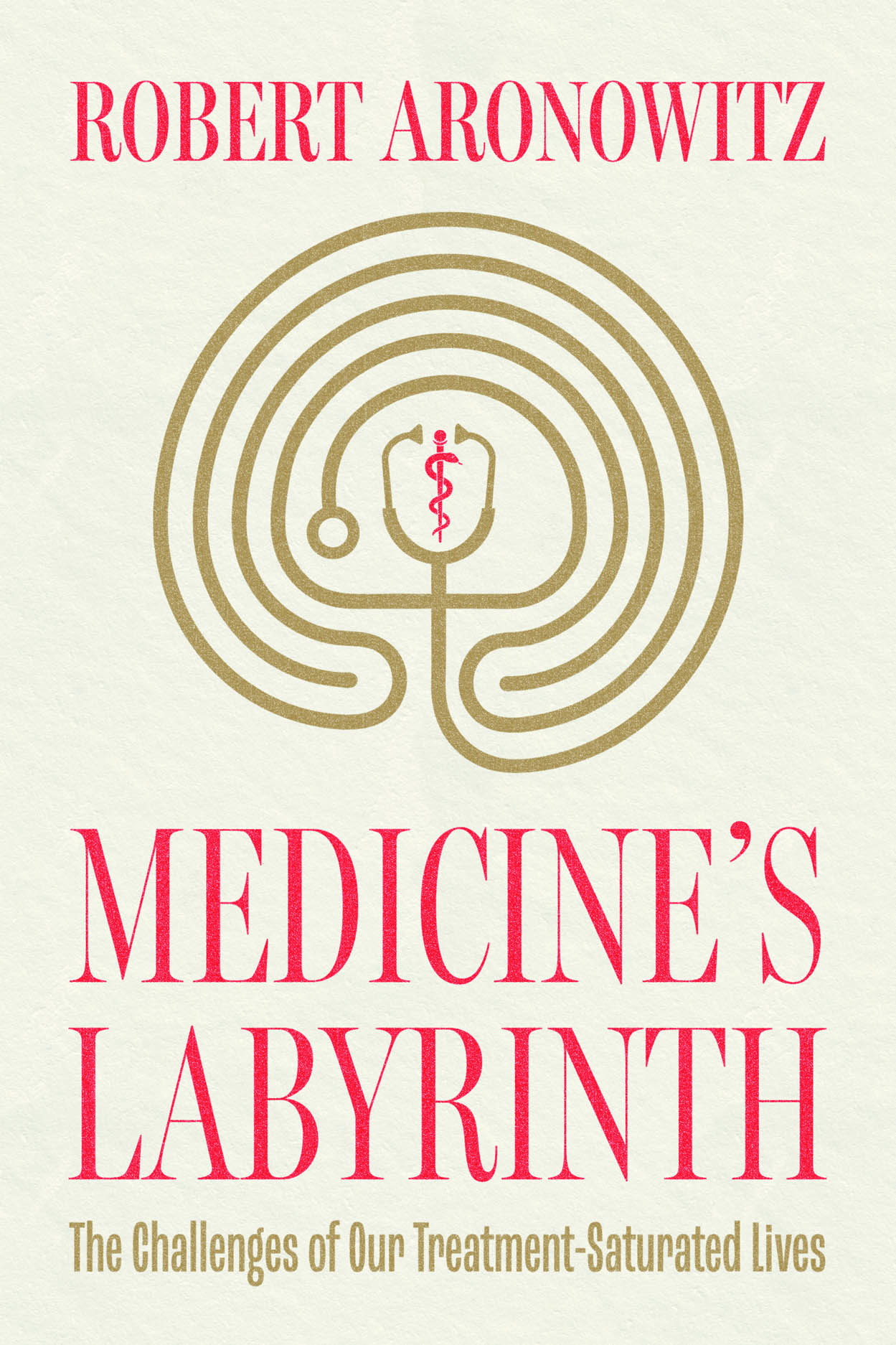
Medicine’s Labyrinth
The Challenges of Our Treatment-Saturated Lives
Medicine’s Labyrinth
The Challenges of Our Treatment-Saturated Lives
A physician diagnoses why doctors and patients face so many uncertainties as they navigate a dizzying array of medical treatments and technologies—and lays out a treatment plan for better health care.
Americans now depend on ever more potent drugs, devices, and procedures. While many of these interventions can improve our health and extend our lives, their widespread availability has created a medical landscape where patients make increasingly complex choices about their care.
In Medicine’s Labyrinth, physician historian Robert Aronowitz examines the challenging decisions posed by the widespread use of so many medical interventions. Drawing on medical literature, patient accounts, and historical case studies, he shows how medical progress can erode certainty, transform the illness experience, and deepen dependence on technology. To understand how these challenges have played out over the past century, Aronowitz explores medicine’s attempts to safely resuscitate premature infants, treat prostate cancer, and deal with too many disease diagnoses. He concludes with a call for physicians to pay renewed attention to patients’ lived experiences and to offer clinical judgments grounded in observations rather than algorithms.
Medicine’s Labyrinth is a clear-eyed exploration of how the very successes of modern medicine have made care harder, and why the fragile trust that sustains its institutions, policies, and practices must be rebuilt.
Reviews

Table of Contents
Preface
Introduction
Part 1. Challenges
1. N of 1: Making Individual Decisions in Intervention-Saturated Societies
2. The Blurred Experience of Disease and Intervention
3. Downsides to Upsides: Our Dependency on Interventions and Vulnerability to Their Loss
4. The Entangling of Clinical Practice With Experiments
Part 2. Cases
5. “We Still Don’t Know”: The Challenges of Resuscitating the Youngest, Most Intervened-In Bodies
6. Prostate Cancer: People Transforming a Diagnosis, and a Diagnosis Transforming People
7. Overdiagnosis: The Right Diagnosis?
Part 3. Looking Forward
8. Loosening the Knots
Acknowledgments
Notes
Index