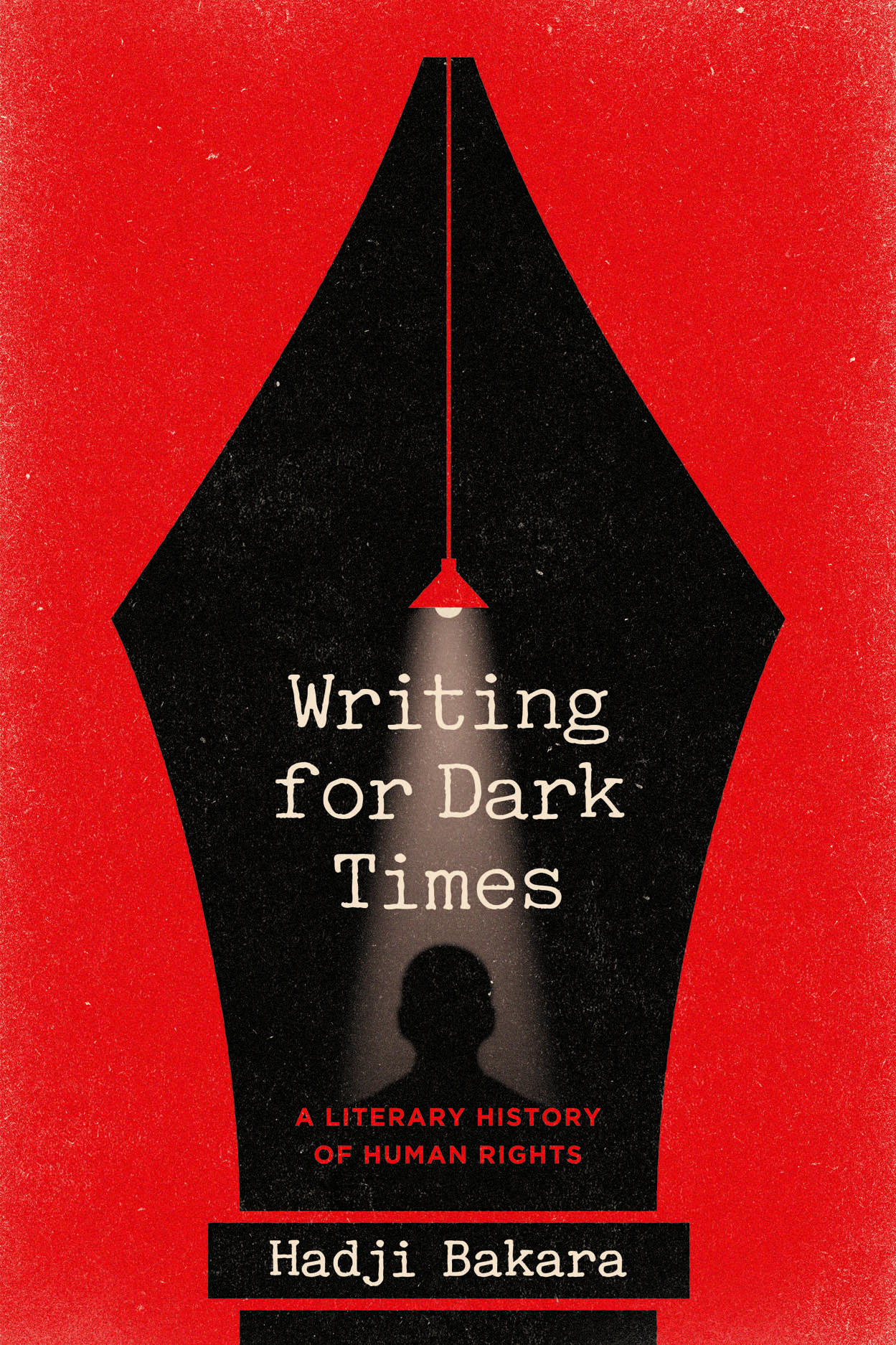
Writing for Dark Times
A Literary History of Human Rights
Writing for Dark Times
A Literary History of Human Rights
A history of human rights that places writers and their ideas at its center.
At Amnesty International’s headquarters in London hangs a large copy of Seamus Heaney’s “From the Republic of Conscience,” a poem that touches on neither imprisonment nor torture but instead suggests that acts of literary creation are themselves a form of human rights work, important for bringing new things into the world rather than removing evil from it. Why does a poem about the power of creation stand at the center of an organization known for publicizing atrocity? What can it tell us about human rights?
Hadji Bakara’s Writing for Dark Times tells the story of the writer’s distinct place in the history of human rights. It argues that the relationship between the creative work of writing and the pursuit of universal rights is an important but misunderstood dimension of both literary and human rights history over the past century. Following a diverse cast of writers from the First World War through the end of the Cold War, including Bertolt Brecht, Anna Seghers, Archibald MacLeish, Albert Camus, Czeslaw Milosz, Ngũgĩ wa Thiong’o, Seamus Heaney, Nadine Gordimer, and J.M. Coetzee, Bakara shows how their efforts to theorize and support human rights were bound up with changing ideas about the place of their own work in the world––the work of writing. And across the twentieth century, the book reveals, two central ideas about writing took shape around the politics of human rights. Writing creates something new and inspires the will for change.
For those who study human rights, Writing for Dark Times offers both an archive and a method for better understanding the influence of writers on the historical development of the concept. For those in literary studies, the book provides a new account of how human rights shaped the politics of twentieth-century literature. Few books have made as vivid a case for literature’s relevance to our most exalted ideals and institutions.
336 pages | 29 halftones | 6 x 9 | © 2026
Literature and Literary Criticism: General Criticism and Critical Theory
Reviews

Table of Contents
Introduction: On Writing and Human Rights History
Part I: The Refugee
1. Stateless Writing
2. The Problem of the Refugee Writer
Part II: The Legislator
3. Poetry in the Shadow of Human Rights
Part III: The Prisoner
4. The Writer’s Freedom
5. The Prisoner’s Pressure
Part IV: The Witness
6. Suffering and the Fate of Utopia
Conclusion: The Writer’s Imagination and the Imagination of the State
Acknowledgments
Notes
Index
Author Events
Hadji Bakara will read from and discuss Writing for Dark Times at NYU
Hadji Bakara will read from and discuss Writing for Dark Times at NYU. For more information, visit the NYU site.
NYU English Department
244 Green Street #106
New York, New York
John Yau will read from and discuss Diary of Small Discontents at the Poetry Society of America
John Yau will read from and discuss Diary of Small Discontents at the Poetry Society of America. For more information and tickets, visit the Poetry Society site.
Poetry Society of America
119 Smith Street
Brooklyn, New York